
Idlers are extremely essential components in the conveying process, playing a key role in ensuring efficiency and durability of conveyor systems. They allow conveyor belts to carry heavier loads while maintaining smooth and consistent movement throughout the operation. By supporting the belt at regular intervals, idlers help distribute the weight of both the belt and the material being transported, reducing stress on any single point. These rollers hold up the belt and rotate along with it, minimizing friction and enabling seamless motion.
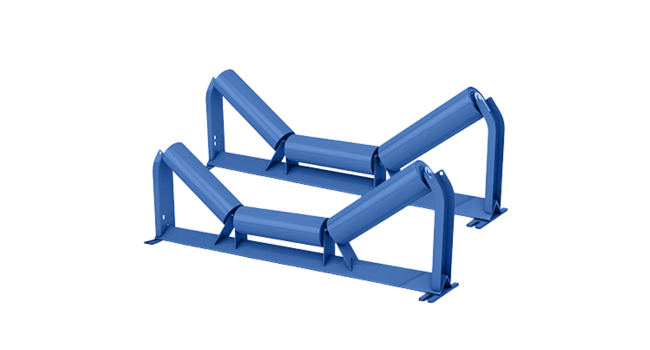
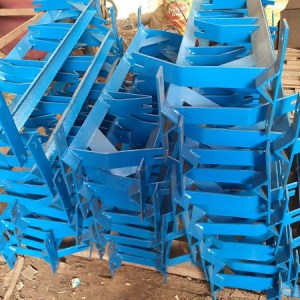
Idlers are designed in various sizes and configurations to match specific operational requirements. They differ in length, diameter, and type depending on factors such as belt width, conveyor speed, material load, and environmental conditions. For instance, heavy-duty applications require robust idlers with larger diameters, while lighter systems can operate with smaller, more compact designs.
There are two main types of conveyor idlers, carrying idlers and return idlers. Carrying idlers support the belt that moves the material, while return idlers support the empty belt.
Overall, idlers are vital for maintaining belt alignment, reducing wear and tear, and ensuring a reliable and efficient conveying system.
The idlers are designed as per IS:8598/ISO-1537/IPSS-2-03-004-85 Which are effectively handled by appropriately sized Idler.
| Belt Width (mm) |
Three Roll
Troughing Idler Length (mm) |
Two Roll Return Idler Length (mm) |
Single Roll Return Idler Length (mm) |
Roller Diameter (mm) |
Bearing Size (mm) |
Shaft Diameter at Bearing (mm) |
|---|---|---|---|---|---|---|
| 500 | 200 | 600 | 76.1-88.9-101.6 | 20 | 20 | |
| 650 | 250 | 750 | 88.9-101.6-114.3 | 20 | 20 | |
| 800 | 315 | 465 | 950 | 101.6-114.3-127.0 | 20 | 20 |
| 1000 | 380 | 600 | 1150 | 114.3-127.0-139.7 | 20-25 | 20-25 |
| 1200 | 465 | 700 | 1400 | 127.0-139.7-152.4 | 20-35-30 | 20-35-30 |
| 1400 | 530 | 800 | 1600 | 127.0-139.7-152.4 | 20-35-30 | 20-35-30 |
| 1600 | 600 | 900 | 1800 | 139.7-152.4-168.3 | 25-30-40 | 25-30-40 |
| 1800 | 670 | 1000 | 2000 | 139.7-152.4-168.3 | 25-30-40 | 25-30-40 |
| 2000 | 735 | 1100 | 2200 | 139.7-152.4-168.3 | 25-30-40 | 25-30-40 |
| 2400 | 900 | 1350 | 2700 | 152.4-168.3-193.7 | 30-40-45 | 30-40-45 |
| 2800 | 1035 | 1152 | 3100 | 168.3-193.7-219.1 | 40-45-50 | 40-45-50 |
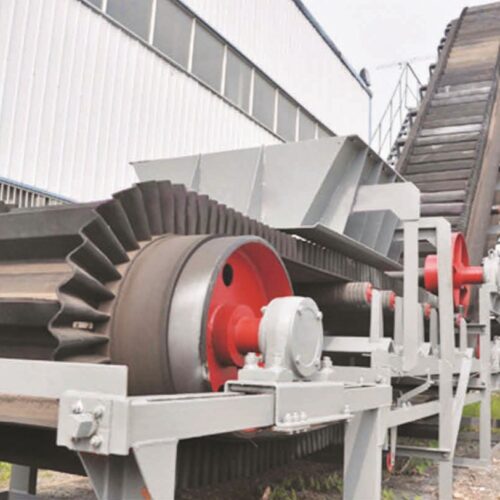
Pulleys are critical components in conveyor systems, responsible for holding, guiding, and driving the belt during operation. They rotate on their shafts and help maintain proper belt movement, ensuring that the conveyor runs smoothly and efficiently. By providing the necessary traction and direction, pulleys play a key role in preventing belt misalignment, excessive wear, slippage, and potential damage caused by improper tracking or incorrect tension.Different types of pulleys are used within a conveyor system, such as drive pulleys, tail pulleys, bend pulleys, and snub pulleys, each serving a specific function. The drive pulley, for example, is powered by a motor and is primarily responsible for moving the belt, while other pulleys help in changing the belt direction or maintaining tension.
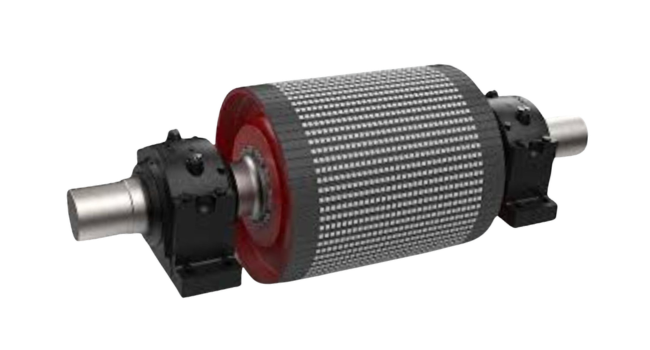
Pulleys are designed in a variety of sizes and specifications to meet different operational needs. They vary in diameter, face width, type, lagging (such as rubber or ceramic coating), and overall construction. These variations are selected based on factors like belt width, conveyor speed, load capacity, and environmental conditions such as moisture, dust, or extreme temperatures.
Proper selection and maintenance of pulleys are essential for ensuring optimal performance, reducing downtime, and extending the lifespan of both the belt and the conveyor system.
The pulley are designed as per IS:8531/ IPSS: -2-03-007-88 Which are effectively handled by appropriately sized Pulley.
Leading manufacturer of belt conveyor systems, bucket elevators, screw conveyors, vibrating screens, idlers, pulleys, steep angle conveyors, roll crushers, hammer mills, impact crushers, and travelling trippers in Kolkata
© 2026 Dynamove Equipments. Design & Develop by VS Digitech